Members
Permanent members
- Simon Abelard (Associate professor, Paris)
- Rocco Brunelli (Associate professor, Paris)
- Ludovic Perret (Full professor, Paris)
- Loïc Rouquette (Associate professor, Paris)
- Martina Vigorito (Associate professor, Paris)
Research engineers
- Elouan Gros (part-time, Astran, EPITA-Astran joint team)
- Alban Bertrand (Paris LRE, with Elsia, co-supervised with Eric Moulines)
Postdocs
- Pilar Coscojuela Escanilla (Paris LRE, since 2026)
PhD Students
- Marie Bonboire (Paris, with Sorbonne University/LIP6/Polsys, since 2026)
- Ulysse Dupont-Latapie (Paris LRE, COFRA thesis with Gendarmerie Nationale, since 2024)
- Dayane Horkos (Paris LRE, CIFRE thesis with Astran, since 2025)
- Mohamed Malhou (Paris LRE, thesis with Meta AI Paris, since 2024)
- Marco Marlesin (Lyon LRE, thesis funded by AID and EPITA)
- Hugo Mayer (Paris LRE, CIFRE thesis with Orange, since 2026)
Former members
- River Moreira Ferreira
- Christopher Battarbee (Post-doc, now at Quantum Software Lab, University of Edinburgh)
Research
Keywords
- Quantum-safe cryptography, Post-quantum cryptography (PQC), Multivariate cryptography, Quantum Key Distribution (QKD), Symmetric cryptography, Block ciphers, Automated cryptanalysis, Machine learning cryptanalysis, Algebraic cryptanalysis, Gröbner bases, Machine learning, PQC/QKD hybrid key exchange, PQC migration
Context and Motivation
The advent of large-scale quantum computers poses a significant threat to the security of most currently deployed asymmetric cryptosystems, such as RSA, Diffie-Hellman, or elliptic curve cryptographic standards. Their security relies on the computational difficulty of mathematical problems, such as integer factorization or the discrete logarithm problem, that can be broken with Shor's quantum algorithm.
Quantum-safe cryptography is an umbrella term for cryptosystems that remain secure against quantum computers. It covers three families: symmetric cryptography; post-quantum cryptography, based on new mathematical problems assumed hard against a quantum computer; and quantum cryptography, such as QKD, whose security relies on the laws of quantum physics rather than on computational assumptions.
Research Objectives
The SECUSYS team studies quantum-safe cryptography as a whole. We address both fundamental and practical questions raised by the large-scale deployment of quantum-safe cryptography: how secure are the proposed schemes, how can they be made more secure and more efficient, and how can they be integrated seamlessly into existing infrastructures?
Main Research Axes
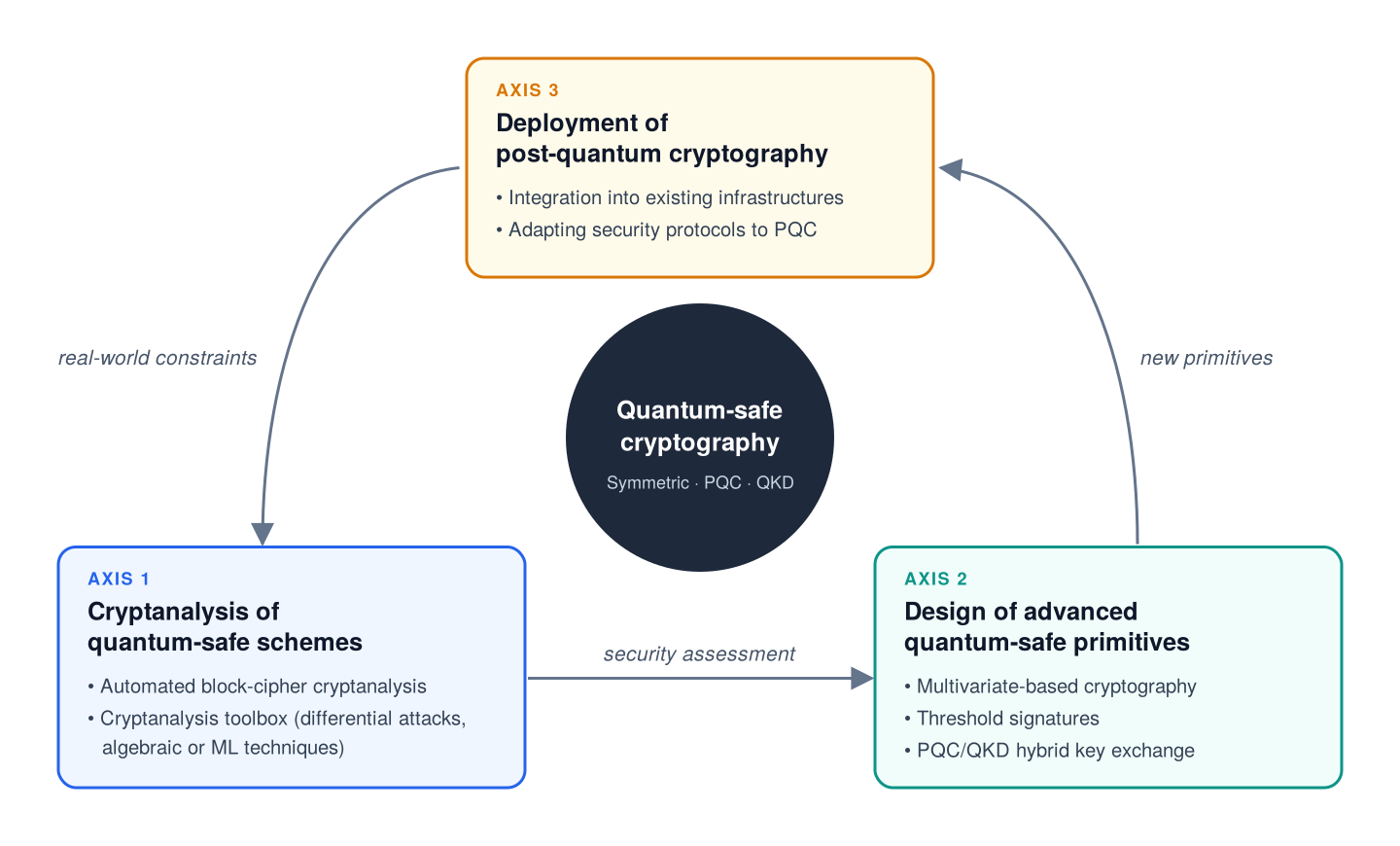
Our contributions are organised in three interconnected axes:
- Cryptanalysis of quantum-safe schemes. We design efficient software tools for automating and rapidly prototyping the cryptanalysis of block ciphers, and develop new algorithmic approaches to assess the security of the hard problems underlying post-quantum cryptography. To this end, we combine algebraic cryptanalysis and computer algebra with emerging machine learning techniques.
- Design of advanced quantum-safe primitives. We design new post-quantum primitives offering stronger security guarantees and improved efficiency, with a particular focus on multivariate-based cryptography and on advanced functionalities such as threshold signatures. We also study the hybridization of classical and post-quantum cryptography with QKD. This includes the development of provably secure hybrid authenticated key exchange protocols for dual-use applications.
- Deployment of post-quantum cryptography. We address the seamless integration of post-quantum cryptography into existing infrastructures. This includes adapting security protocols to the specificities of post-quantum schemes.
Software
- TAGADA: an automated tool, based on constraint programming, for finding and instantiating truncated differential characteristics of block ciphers
Some Projects
Collaborative Projects
- ANR Everlastique
Industrial Projects
- Joint EPITA and Astran lab
- Chaire "Impact of Quantum to Cybersecurity"
- CIFRE theses with Orange and Astran
Selected Publications
- S. Abelard, L. Perret, H. Shi. "A Polynomial-Time Key Recovery Attack of Facto-DSA". ACM PQQS 2026.
- S. Abelard, J. A. Vieira Giestinhas, D. Kahrobaei, L. Perret, T. Spiller, C. Striecks. "Assessment of Provably Secure Hybrid Authenticated Key Exchange for Dual-use Applications". EPJ Quantum Technology.
- A. Caminata, E. Gorla, M. Mabe, M. Vigorito, I. Villa. "Cryptanalysis of a Multivariate CCZ Scheme". DCC 2026.
- F. Delobel, P. Derbez, A. Gontier, L. Rouquette, C. Solnon. "A CP-based Automatic Tool for Instantiating Truncated Differential Characteristics". INDOCRYPT 2023.
- M. Espie, H. Mayer, L. Perret. "A Differentiated Approach for Post-Quantum DNSSEC". AsiaCCS 2026.
- E. Gros, D. Horkos, R. Moreira Ferreira, L. Perret. "DUOV: A Dressing in Advance for Threshold UOV with Pre-signing". NIST MPTC 2026.
- K. Lauter, M. Malhou, L. Perret. "HATSolver: Learning Groebner Bases with Hierarchical Attention Transformers". ICLR 2026.
Related Publications
[1]
Fraņois Delobel • Patrick Derbez • Arthur Gontier • Loïc Rouquette and Christine Solnon. "A CP-based Automatic Tool for Instantiating Truncated Differential Characteristics". Conference on Cryptology in India (INDOCRYPT). 2023. https://doi.org/10.1007/978-3-031-56232-7_12.